The question that led me to build Fanout
While researching AEO and GEO, I came across a detailed article about how AI platforms answer a query. The explanation of query fan-out caught my attention: a broad question can lead to several narrower searches as a system gathers information for an answer.
It made me question how I was approaching optimisation. I wanted to understand the relationship between the questions being explored, the information a page provides and the sources that end up being cited. I felt that this part of the process deserved more attention in the discussions I was reading.
I researched further and started exploring what a query fan-out audit could look like. My aim was to help website owners identify missing answers, build on useful existing content and make their pages stronger candidates for inclusion in AI answers.
That became Fanout. The tool generates possible sub-questions and checks page coverage to help shape a practical content brief. Improving the chance of being cited is the goal; the audit itself does not demonstrate a citation improvement.
The problem the tool addresses
A keyword gives an audit a starting point. It does not, on its own, describe every question a reader might need answered. A page about cruises from Southampton, for example, could address destinations while leaving a reader uncertain about when to book. These are different information needs within the same topic.
Fanout makes those potential gaps explicit. The workflow asks models for likely sub-questions, groups related questions and checks the page for answers. It gives an SEO practitioner a structured starting point for a content review.
The tool simulates possible questions. It does not observe the hidden retrieval queries used by a search engine, and a model-generated question is not evidence that people search for it.
How an audit becomes a brief
An audit starts with a keyword and page content. The documented workflow can use a fetched page or supplied content when access fails. That matters because a recommendation is only as useful as the content the tool actually reviewed.
- Generate likely sub-questions independently with Claude, OpenAI, Perplexity and Gemini.
- Filter questions that describe page structure rather than a reader's information need.
- Group similar questions and record how many models raised each theme.
- Assess each question cluster as covered, partial or missing against the supplied content.
- Assign priorities and prepare content outlines for the most important gaps.
Model agreement is a prioritisation signal within this workflow. Four models suggesting a question does not make it a verified search demand signal. Search Console inputs can add observed query data, and the two kinds of evidence should remain distinguishable.
A real sample: 34 clusters, 18 partial, 16 missing
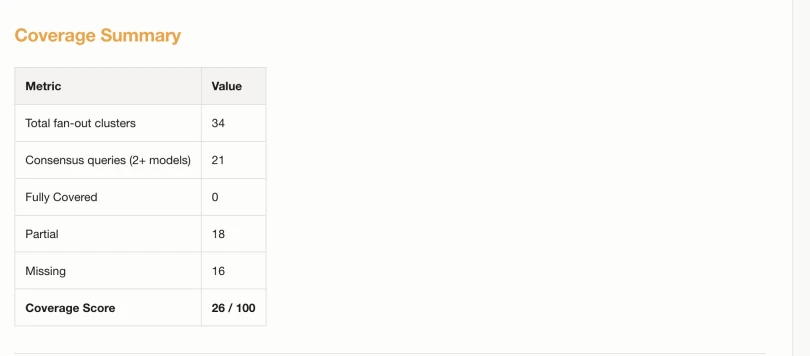
In the anonymised cruise-page audit shown here, dated 3 October 2026, Fanout generated 34 question clusters. Twenty-one were raised by at least two models. The run classified 18 clusters as partially covered and 16 as missing, producing a coverage score of 26/100.
One missing question was: how far in advance should you book a cruise from Southampton? All four models raised that theme, and it received a P1 priority. The practical next step is to check whether booking guidance belongs on that page, whether a useful answer already exists elsewhere on the site, and which facts the business can substantiate.
Only then should someone write or commission the answer. A generated brief cannot supply trustworthy booking windows or offer conditions without a verified source.
The decisions I want the report to support
A missing answer does not automatically require a new page. Sometimes the right action is to improve the current page. Sometimes another page already answers the question and needs a useful internal link. Some questions fall outside the purpose of the audited page and should be excluded.
Fanout supports site inventory checks to help distinguish these actions. Its report can be exported as Markdown, PDF or JSON, so recommendations can move into an editorial or implementation workflow. The handoff should make the question, evidence, proposed action and destination page clear.
The documented build also includes a guard asking generated outlines to use placeholders for unverified facts. That is a useful check, but a person still needs to review the outline before it becomes published copy.
What the score can and cannot tell you
The 26/100 score describes the model's assessment of coverage against this run's generated question set. It is not a citation rate, a probability of appearing in an AI answer, or a measure of traffic.
The same sample projected 41/100 after P1 fixes and 68/100 after P1 and P2 fixes. Those figures are calculated coverage scenarios. They are not measured improvements after implementation. No ranking or citation uplift has been established by this sample.
Repeat runs may produce different questions. Some competitor-related suggestions may also be inappropriate for a brand page. Those limitations make relevance checks and a recorded audit scope important.
A useful way to apply the output
Start with one important page and a defined audience. Review the generated questions, remove irrelevant ones and confirm the content the tool assessed. Turn a small number of supported gaps into actions, with an owner and a way to check whether each change helped.
That is the role I want Fanout to play: organise a content investigation and make its next steps easier to act on. Any claim about improved search performance needs its own measurement after changes are published.
Based on my account of building Fanout, the product handoff dated 2 October 2026 and the anonymised report dated 3 October 2026. Feature descriptions refer to that documented version.

Senior SEO, AEO & GEO consultant and practitioner. I write about search strategy, the tools I build and lessons from hands-on work.
More about my work →TAKE THE NEXT STEP
Put the questions to work.
Use the free content audit planner or discuss a focused review of one important page.
Need help with a wider search challenge? Explore SEO consulting.